POS systems for doctors, dentists and medical practices
Simple POS systems for private practices, dental surgeries, clinics, dental hygiene, physiotherapy and other healthcare providers. Suitable for recording direct patient payments and everyday practice operations.
Choose a registerA POS system for a medical or dental practice
Medical practices also need a simple way to record payments, issue documents, keep an overview of amounts received and handle cash and cashless payments without unnecessary administration.
A POS system for a doctor or dentist need not be complicated. A small practice may only need a tablet or mobile device, while a larger clinic can use a conventional register or computer-based solution to match its operation.
Choose according to the actual number of payments, users and devices in the practice rather than buying an unnecessarily complex setup.
Which practices and healthcare providers is the solution suitable for?
The systems suit small private practices as well as larger healthcare workplaces. Dentists, dental surgeries and dental hygiene providers are a particularly important group because patients often pay directly on site.
Dental hygiene
General practitioners
Paediatrics
Gynaecology
Dermatology
Ophthalmology
ENT
Orthopaedics
Neurology
Allergology and immunology
Urology
Psychiatry
Physiotherapy and rehabilitation
Private outpatient practices
Private clinics
A solution for dentistry
POS systems for dentists and dental practices
Dental practices often accept direct patient payments for treatments, services or patient-funded materials. Payment may be made in cash, by card or QR code in the practice, so dentists need a simple way to record it.
A POS system can simplify issuing documents, recording amounts received and monitoring sales. Depending on the practice, a conventional register, tablet or mobile solution may be suitable.
Before EET 2.0 starts, direct patient payments are one of the areas practices will need to configure correctly.
Updated 16 September 2026
EET 2.0 for doctors, dentists and medical practices
Being a doctor, dentist or medical practice does not create an automatic general exemption from EET 2.0. The decisive factors are whether the income is qualifying business income, how it is paid and whether a statutory exemption applies.
A direct cash payment from a patient is typically recorded, as is a card or QR payment made during personal contact in the practice. Cash is recorded even without personal contact.
A later remote payment of an invoice by ordinary bank transfer is typically not recorded.
Our complete EET 2.0 guide explains dates, payment types, certificates and further rules.
In detail: EET 2.0 for doctors and dentists
Complete EET 2.0 guide → Who does EET 2.0 apply to and who must record sales? Which payments are recorded in EET 2.0?Official sources: EET 2.0 – Czech Financial Administration and definition of recorded income.
Which payments in a practice may be subject to EET 2.0?
| Situation | EET 2.0 recording |
|---|---|
| Patient pays cash in the practice | Usually yes |
| Patient pays by card in the practice | Usually yes |
| Patient pays by QR code in the practice | Usually yes |
| Patient receives an invoice and pays later by bank transfer | Usually no |
| Payment is made remotely without personal contact | Usually no |
| Payment is made in another way | Depends on the conditions |
Cash is recorded even without personal contact. For a cashless payment, the key question is whether it is a contact payment made during personal contact or directly on the premises.
What about payments from health insurers?
A payment sent remotely to a practice by a health insurer is not a patient contact payment made during personal contact in the practice.
Practices therefore need to distinguish reimbursements from health insurers from direct patient payments. The payment method matters particularly for direct patient payments.
EET does not send a diagnosis or treatment description
According to the Czech Financial Administration, EET does not require information about what was purchased or the nature of the service. A patient diagnosis or description of a specific medical treatment is therefore not part of the record.
EET works with data needed to record a sale, such as business identification, the recording unit, date, time and total amount.
Data sent to the Czech Financial Administration →Which POS system should a practice choose?
Small practice
A simple tablet or mobile solution may be suitable when the practice accepts only a small number of direct payments.
Dental or busier outpatient practice
A standalone touchscreen register or device with a connected printer may be more practical when more payments are accepted throughout the day.
Clinic or multiple workplaces
Larger operations need an overview of individual workplaces and sales. Choose a solution that reflects how the clinic actually operates.
Current POS solutions for medical practices
We selected current systems suitable for services, smaller operations and mobile use. Prices and links come from the same product catalogue as on our other sector pages.


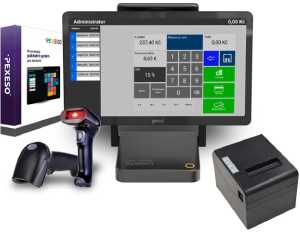
An All-in-One PC running Android with the unlimited PEXESO POS system is a striking design element, and its performance covers larger venues too. It also comes with an 80 mm thermal receipt printer, a scanner and a cash drawer.
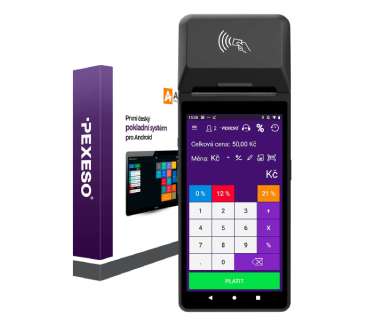
The CIONTEK mobile touch register with the PEXESO Calculator software prints receipts on its built-in thermal printer, scans codes with the camera and accepts card payments via GPTom and Viva Wallet.

Practical features
What can a POS system make easier in a practice?
- quick entry and recording of payments
- issuing a document to the patient
- handling cash and cashless payments
- an overview of amounts received and sales
- simple statistics and reports
- connecting or using a built-in printer
- mobile use on a suitable device
Doctors’ and dentists’ frequently asked questions about EET 2.0
Does EET 2.0 also apply to doctors and dentists?
Being a doctor or dentist does not create an automatic general exemption. The decisive factors are the business income, method of payment and any statutory exemption; direct patient payments are especially relevant.
Will a dentist record a card payment?
A card payment made directly in a dental practice is a contact payment and is recorded when the remaining statutory conditions are met.
What about a QR payment in the practice?
A QR payment made by a patient during personal contact in the practice is typically a reportable contact payment.
Must a practice record a conventional bank transfer?
If a patient receives an invoice and pays it later remotely by normal bank transfer, it is not a contact payment and is usually not recorded.
Must a doctor buy a new register because of EET?
Not automatically. EET 2.0 can be operated on different device types as long as the software supports the required communication with the Financial Administration system.
Must a dentist print an EET receipt?
The sales-recording law does not require an EET receipt to be issued or printed. Other rules may still require a different document.
Do you need a POS system for your practice?
We will help you choose a simple solution for the number of payments, devices and operating model of your practice.
Help me chooseDO YOU NEED A POS SYSTEM
FOR YOUR PRACTICE?
Leave us your contact details. We will help you choose a solution for the way your practice operates.